
How to Run a Fairer, Faster Tender Process with E-Tendering
Introduction
Running a tender is one of the most consequential things a procurement team does. It determines which suppliers your organization works with, at what price, and under what terms. Yet in many organizations across Malaysia, the tender process still relies on email, printed evaluation sheets, and informal scoring conversations — creating unnecessary risk on every engagement.
This article walks through why manual tendering falls short, how a structured e-tendering cycle works, and what procurement teams can do to run fairer, faster, and more auditable sourcing processes.
Why Manual Tendering Creates Problems
When tender processes run through email and paper, three categories of risk emerge consistently:
- Compliance risk — without a structured system, it is difficult to prove that all vendors received identical information, that evaluation criteria were applied consistently, or that decision-makers had no undisclosed conflicts of interest.
- Operational delay — coordinating committee members, collating vendor submissions by email, and manually tabulating scores is time-consuming and error-prone.
- Audit exposure — if a procurement decision is ever questioned internally or externally, a paper-based process rarely produces the level of documented evidence needed to defend it.
These are not hypothetical problems. They are the day-to-day reality for procurement teams that have outgrown their manual tools.
The Structured E-Tender Cycle
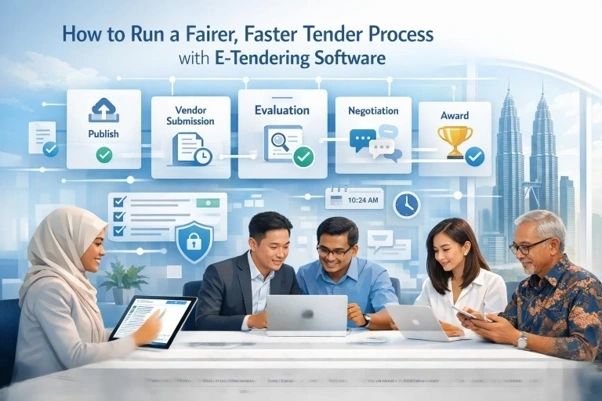
An e-tendering platform replaces the informal email-based process with a structured, end-to-end workflow:
- Publish — the tender is created in the system with defined criteria, scoring weights, document requirements, and a submission deadline. All invited vendors receive the same information simultaneously.
- Vendor Submission — vendors respond through a self-service portal, uploading documents, pricing, and supporting materials directly. No procurement staff data entry required.
- Evaluation — a defined evaluation committee scores each submission against the published criteria within the platform. Scores are captured digitally, weighted automatically, and visible only to authorized committee members.
- Negotiation — if a negotiation round is needed, it is conducted within the platform with a full audit trail of offers and counteroffers.
- Award — the award decision is issued electronically, with a full record of scoring, rationale, and approvals preserved for audit purposes.
Every step is timestamped and traceable. Nothing happens outside the system.
How Vendor Self-Service Reduces Your Team's Workload
One of the most underappreciated benefits of e-tendering is what it removes from your team's plate. When vendors manage their own registration, document submission, and tender responses, procurement officers are freed from acting as data-entry intermediaries.
Vendor self-service also improves data quality. Vendors are accountable for the accuracy of their own submissions. Documents are uploaded directly — not forwarded through email chains where attachments get lost or corrupted. Vendor profiles are maintained by the vendor, keeping your supplier registry current without manual upkeep.
E-Tendering vs. Email-Based Tendering: A Compliance Comparison
The difference between an e-tendering system and an email-based process is not just efficiency — it is a fundamentally different risk profile:
- Consistency — an e-tendering platform ensures every vendor receives identical tender documents and has the same submission window. Email processes frequently result in inadvertent information asymmetry.
- Evaluation of integrity — scoring in a structured platform is applied independently by each committee member, with the system enforcing the agreed criteria. Email-based scoring is informal and vulnerable to anchoring and social influence.
- Audit trail — a digital system captures every action: when a document was uploaded, when a score was entered, when an award was issued. Email threads do not.
- ISO 27001 alignment — for organizations operating under ISO 27001 or preparing for certification, a digital tender process with access controls and audit logs is far easier to demonstrate compliance than an email-based one.
Ready to Modernize Your Sourcing Process?
Request a Free Demo or Requirement Gap Analysis
Unsure how e-tendering would fit into your existing procurement workflow? Our team will map your current sourcing process against WeManage's tender management module and identify where you can gain the most ground — quickly.
Visit wemanage.cloud or contact us at enquiry@wemanage.cloud to book your session.
WeManage is an ISO 27001:2022 certified e-procurement SaaS platform. Its tender management module supports the full sourcing lifecycle — from vendor registration through to award — in a single, connected system.