
Why an Integrated eProcurement System Outperforms Spreadsheets
Introduction
A purchase order gets signed. A vendor delivers. An invoice is paid. Most organizations treat this sequence as the end of the procurement story. But for businesses managing multiple suppliers and recurring engagements, what happens after award — the contract — is where much of the risk lives.
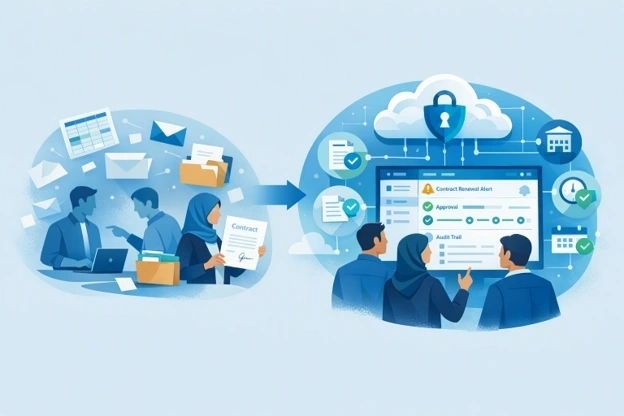
Many procurement teams still manage contracts through a combination of shared drives, email threads, and spreadsheets. This article explains why that approach carries hidden costs, what a proper contract lifecycle looks like, and how an integrated eProcurement system changes the game.
The Hidden Cost of Unmanaged Contracts
Contracts that live outside a dedicated system tend to cause the same categories of problems, repeatedly:
- Missed renewal dates — when contract expiry is tracked in a spreadsheet that one person maintains, renewals get missed. The consequence ranges from an unintentional lapse in service coverage to an automatic rollover on unfavorable terms.
- Version disputes — when contracts are circulated and revised by email, it becomes difficult to establish which version was signed. This creates ambiguity in the event of a dispute.
- No audit trail — who approved the contract? When was the final version agreed? Who authorized the renewal? Without a system, these questions are unanswerable after the fact.
- Compliance exposure — for organizations subject to audit, procurement governance standards, or ISO certification, the inability to demonstrate proper contract control is a material risk.
None of these problems require negligence. They happen because the process has no structural support.
The Procurement Contract Lifecycle
A contract in a procurement context does not begin when the document is drafted — it begins at award. A well-managed contract lifecycle covers six stages:
- Award — the commercial decision is made and confirmed in the procurement system, with scoring rationale and approval records preserved.
- Drafting — contract terms are prepared, with the awarded vendor's details and agreed commercial terms linked directly to the sourcing record.
- Internal Approval — the contract routes through the organization's approval workflow before execution — finance, legal, or senior management, depending on value and category.
- Execution — the signed contract is stored in the system with metadata: start date, end date, key milestones, and responsible owner.
- Monitoring — the system tracks contract status and triggers alerts before critical dates: renewal windows, performance review milestones, and expiry.
- Renewal or Close — at the end of the contract term, the system supports a structured decision: renew, re-tender, or close. The outcome is recorded and linked to the full contract history.
What to Look for in a Contract Management Module
Not all contract management capabilities are equal. When evaluating whether a system meets your needs, look for:
- Automated expiry alerts — the system should notify contract owners and procurement managers ahead of key dates, not just display them in a report.
- Approval workflows — contract execution should follow the same configurable approval logic as the rest of your procurement process. Separate approval tools create gaps.
- Document versioning — every version of a contract document should be stored and timestamped, with the final executed version clearly flagged.
- Linkage to the full procurement record — a contract is stronger when it is traceable back to the original tender, evaluation scores, and award decision. This traceability is only possible in an integrated system.
Why Integration Changes Everything
Spreadsheet-based contract tracking fails not because spreadsheets are bad tools — they are excellent for what they are designed to do. They fail because contracts do not exist in isolation. A contract is the downstream outcome of a sourcing decision, which came from a purchase requisition, which was authorized by a budget holder. The value of contract management multiplies when that chain of evidence is preserved from end-to-end.
In an integrated eProcurement system, the contract module is not a separate filing cabinet. It is the final stage of a connected workflow that begins at requisition and ends at payment. Every stage feeds the next. Audit queries can be answered in minutes, not days.
ISO 27001 and Contract Security
For organizations holding or pursuing ISO 27001 certification, contract management is a direct concern. Procurement contracts often contain sensitive commercial terms, pricing structures, and vendor credentials. Managing these through email and shared drives creates information security risks that a certified organization is expected to control.
An ISO 27001-certified eProcurement platform provides the access controls, audit logs, and data handling practices that your certification requires — without additional overhead.
Ready to Close the Gaps in Your Contract Process?
Request a Free Demo or Requirement Gap Analysis
Not sure where your current contract management process has gaps? Our team will review your existing workflow and show you exactly how WeManage's integrated contract management module addresses them — at no cost.
Visit wemanage.cloud or contact us at enquiry@wemanage.cloud to book your session.
WeManage is an ISO 27001:2022 certified eProcurement SaaS platform. Its contract management module is fully integrated with the tender, award, and fulfilment cycle — giving your team complete visibility from sourcing decision to contract close.